DIPLOMA COMPUTER ENGINEERING - WORKING PROFESSIONAL

Diploma in Computer Engineering for Working Professional is a three year unaided diploma program with minimum eligibility: Passed 10+2 examination with Physics / Mathematics / Chemistry / Computer Science / Electronics / Information Technology / Biology / Informatics Practices / Biotechnology / Technical Vocational subject / Agriculture / Engineering Graphics / Business Studies / Entrepreneurship Or SSC + 2 years ITI/COE and minimum 1 year full time work experience as per Directorate of Technical Education.

Department is the youngest department in the institute and attracts high quality students started in 2006. In 2024, Working Professional Diploma was sanctioned with an intake of 30 students for students who already are employed and are interested in continuing their education.

Generous grants from management made it possible to develop Computer labs with the latest Hardware and Software. The Department houses classrooms and laboratories with modern infrastructure to facilitate their learning. The academic ambience encourages project based development and innovation activities. Department offers a 3 years Diploma Programme in Computer Engineering. Curriculum is well designed with the help of industry experts and senior academicians.

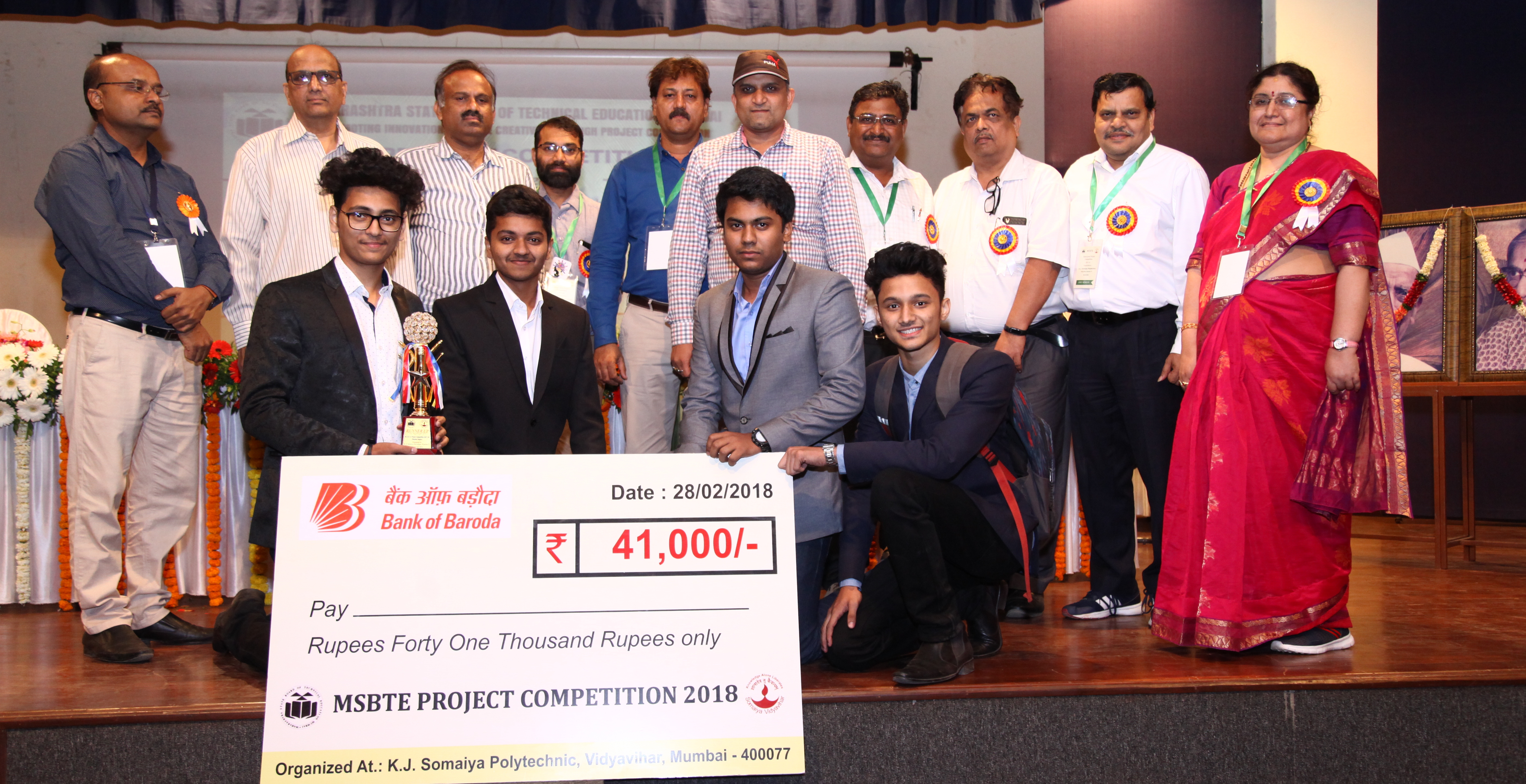
Courses are offered in a perfect hierarchical manner and include extensive practical sessions. All practical exercises are performed using the latest software on the high end machines. Department also promotes open source software development and students have been closely involved with such development projects. Entire teaching faculty is highly motivated and is committed to teaching in classrooms as well as in the labs. Students of this department have brought several laurels to this institute by actively participating and winning several technical competitions including First prize in DIPEX 2014. Department has ambient classrooms equipped with ICT enabled learning technologies and state of the art laboratories. A full fledged Robotics laboratory is developed in collaboration with IITB under the EYantra. Besides this, teaching staff and supporting staff are actively supporting the institute in various activities where IT support is required.
show more... show less...

Key Information

  • Duration
    3 Year
  • Programme Code
    ST1914
  • Course Type
    Diploma
  • Mode of study
    Part time
  • Campus
    Vidyavihar - Mumbai
  • Institute

Pedagogy

Pedagogy includes concoction of traditional teaching and ICT based teaching learning practices like Google Classroom,Think Pair Share and Do it Yourself. Mini-Projects are offered to encourage project based learning among students. The projects are assigned as per students’ choice mapped with knowledge / thrust areas of Mechanical Engineering.Expert lectures, seminars, workshops, soft skills training,entrepreneurship training program, inplant training during vacation, site visits, field visit, hands on training are also included.The curriculum also avails flexibility for students to choose their area of interest as an elective courses in higher semester.The curriculum is aimed to bring about the growth of the students through experiential and practical learnings. Encouraged to opt for on-line certificate courses offered through Coursera.

Differentiators

  • Technical Know How

    The primary focus of our curriculum is to impart technical know-how to students and promote their problem solving skills.

  • Knowledge Levels

    The courses are categorised in to 7 levels as per NEP2020 and NCRF guidelines

  • High Expertise

    The teaching faculty have high expertise in their subjects, passionate about teaching in classroom and practical sessions.

  • Best Teaching Learning

    Experienced and proficient faculty with upgraded and advanced teaching methodologies.

  • Industry Institute Collaboration

    MOU with reputed industries like Limewire, FossEST Technologies, BOAT etc. for internships, industrial visits, expert talk etc.

  • Alumni Association

    Alumni are trendsetters as well Institute backbone.They provide valuable guidance to the students through seminars, workshops,expert talks,internships and related events.

  • Industry Inputs

    The curriculum is designed by our faculty. The institute has signed MoU with industries because of this which students are deputed for full semester internship. This will enhance their on-site skills and get a broader perspective of industry and its application.

  • Technical Competitions

    The Students actively participate in State and National level technical Project and Paper presentation competitions.

  • Continuous counselling

    The process of assisting and guiding students by their respective mentors to resolve especially personal,academics, social, or psychological problems and difficulties.

Career Paths

  • Higher Education
  • Software Developer
  • Database Administrator
  • Computer Programmer
  • Software Testing Engineer
  • Mobile Application Developer
  • Web Application Developer
  • Hardware and Network Engineer

Programme Outcomes

  • PO1: Engineering Knowledge: Apply knowledge of mathematics, natural science, computing, engineering fundamentals and an engineering specialization as specified in WK1 to WK4 respectively to develop to the solution of complex engineering problems.
  • PO2: Problem Analysis: Identify, formulate, review research literature and analyze complex engineering problems reaching substantiated conclusions with consideration for sustainable development. (WK1 to WK4)
  • PO3: Design/Development of Solutions: Design creative solutions for complex engineering problems and design/develop systems/components/processes to meet identified needs with consideration for the public health and safety, whole-life cost, net zero carbon, culture, society and environment as required. (WK5)
  • PO4: Conduct Investigations of Complex Problems: Conduct investigations of complex engineering problems using research-based knowledge including design of experiments, modelling, analysis & interpretation of data to provide valid conclusions. (WK8).
  • PO5: Engineering Tool Usage: Create, select and apply appropriate techniques, resources and modern engineering & IT tools, including prediction and modelling recognizing their limitations to solve complex engineering problems. (WK2 and WK6)
  • PO6: The Engineer and The World: Analyze and evaluate societal and environmental aspects while solving complex engineering problems for its impact on sustainability with reference to economy, health, safety, legal framework, culture and environment. (WK1, WK5, and WK7).
  • PO7: Ethics: Apply ethical principles and commit to professional ethics, human values, diversity and inclusion; adhere to national & international laws. (WK9)
  • PO8: Individual and Collaborative Team work: Function effectively as an individual, and as a member or leader in diverse/multi-disciplinary teams.
  • PO9: Communication: Communicate effectively and inclusively within the engineering community and society at large, such as being able to comprehend and write effective reports and design documentation, make effective presentations considering cultural, language, and learning differences
  • PO10: Project Management and Finance: Apply knowledge and understanding of engineering management principles and economic decision-making and apply these to one’s own work, as a member and leader in a team, and to manage projects and in multidisciplinary environments.
  • PO11: Life-Long Learning: Recognize the need for, and have the preparation and ability for i) independent and life-long learning ii) adaptability to new and emerging technologies and iii) critical thinking in the broadest context of technological change. (WK8)

Curriculum


Semester I
Optional Course
  OOPS Using C++
  Computer Network
  COEP-VI (C++ Lab)
  COEP-VII (PHP Lab)
Optional Computer Programming (Android Programming)
Computer Programming (R - Programming)
Computer Programming(Python Programming)
Optional Computer Programming Lab (Android Programming)
Computer Programming Lab (Python Programming)
Computer Programming Lab (R - Programming)

Milestone

2024

The programme started with an intake of 30 students.